

CIXIN MACHINERY TECHNOLOGY

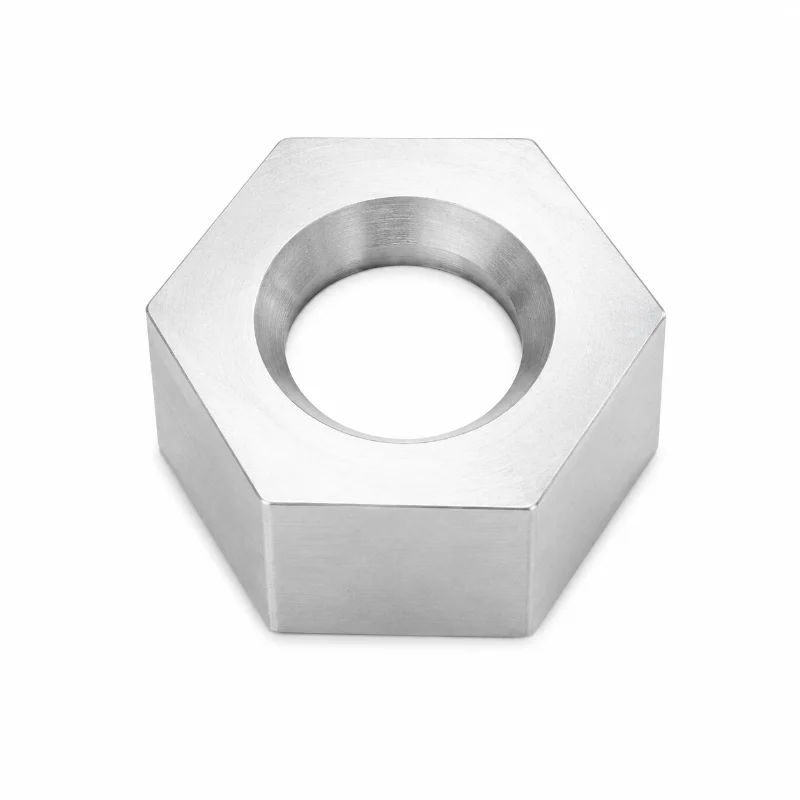
CNC-Turned Hex Spacer
A compact hex spacer component produced for aerospace assemblies that require accurate bore positioning, stable wrenching surfaces, and reliable dimensional consistency. This part reflects the value of CNC Turning in producing small metal components with controlled concentricity, clean edge quality, and dependable fit for precision fastening and support functions.
- Dimensional Control: Maintains consistent bore size and across-flat dimensions for stable assembly performance.
- Feature Combination: Integrates a central through-hole with a hexagonal outer profile in one compact part.
- Surface Integrity: Smooth contact faces and clean bore edges reduce assembly interference.
- Process Capability: Combines CNC turning with secondary profile machining for efficient production of functional geometry.
- Application Value: Suitable for lightweight aerospace assemblies that need spacing, positioning, or fastening support.
- Production Flexibility: Supports prototype validation, small-batch production, and repeat orders.
Share:


- Description
- Specification
- Application
- FAQS
This hex spacer is a typical small-format precision part used in aerospace and other high-reliability assemblies where fastening, spacing, and structural positioning must remain stable. Although the geometry looks simple, the machining requirements are not. The part must hold a clean central bore, accurate outer flats, and flat seating faces, while also keeping edge quality under control to avoid burr-related problems during assembly.
The main challenge in machining this type of component lies in balancing round-feature accuracy with hex-profile consistency. The bore must remain concentric and dimensionally stable so that the part can align correctly with mating fasteners, pins, or shafts. At the same time, the outer hex profile must provide reliable tool engagement without corner deformation or excessive dimensional variation. For small parts, even slight burrs around the bore or edges can affect fit, torque transfer, or downstream assembly efficiency.
To achieve this, the process typically starts with CNC turning of the cylindrical stock to generate the reference diameter, end faces, and through-hole. After the primary turning operation, the part can be completed using live tooling on a turning center or a controlled secondary operation to form the hexagonal outer profile. Finishing passes are then used to improve face quality and maintain dimensional stability, followed by edge treatment and deburring to ensure clean transitions around the bore and corners.
The value of this process is not only dimensional accuracy, but also repeatable functionality. A well-machined hex spacer improves assembly reliability, reduces fitting issues, and supports consistent load transfer in compact structures. For aerospace components, this consistency is especially important where lightweight construction, secure fastening, and tight tolerance management all matter.
| Parameter | Details |
| Material | Aluminum 6061 / 7075 / Stainless Steel 303 |
| Outer Profile | Hexagonal |
| Across Flats | 10 mm |
| Bore Diameter | 5 mm |
| Part Height | 8 mm |
| Tolerance | ±0.01 mm on bore, ±0.02 mm on across flats |
| Surface Finish | Ra 0.8–1.6 μm |
| Edge Condition | Deburred, light chamfer on bore edge |
| Production | Prototype, small batch, or volume |
- Aerospace Assemblies: Spacer and support elements in lightweight structural systems.
- Fastening Systems: Positioning parts for bolts, shafts, or precision threaded connections.
- Instrumentation Modules: Compact support components in mechanical and sensing assemblies.
- Precision Equipment: Small metal inserts or standoffs requiring accurate bore alignment.
Q1: What is the main machining challenge of this hex spacer?
The key challenge is maintaining the relationship between the central bore and the outer hex profile while keeping the end faces flat and the edges clean. Small deviations can affect fit and assembly performance.
Q2: Why is CNC Turning suitable for this type of part?
CNC Turning provides accurate control of the bore, end faces, and reference diameters. It creates a stable foundation for the finished geometry and supports consistent repeatability in small precision parts.
Q3: How is the hex outer shape produced if this is a turning case?
The bore and primary body are first created through CNC turning. The hex profile is then formed through live tooling on a turning center or a controlled secondary machining step, depending on the production setup.
Q4: What value does this part bring to aerospace assemblies?
It helps maintain spacing, alignment, and fastening stability in compact assemblies. Accurate bore size and controlled outer geometry improve installation efficiency and long-term reliability.
Q5: Can the size and material be customized?
Yes. The bore diameter, across-flat size, height, material, and edge treatment can all be adjusted according to the drawing and application requirements.