

CIXIN MACHINERY TECHNOLOGY

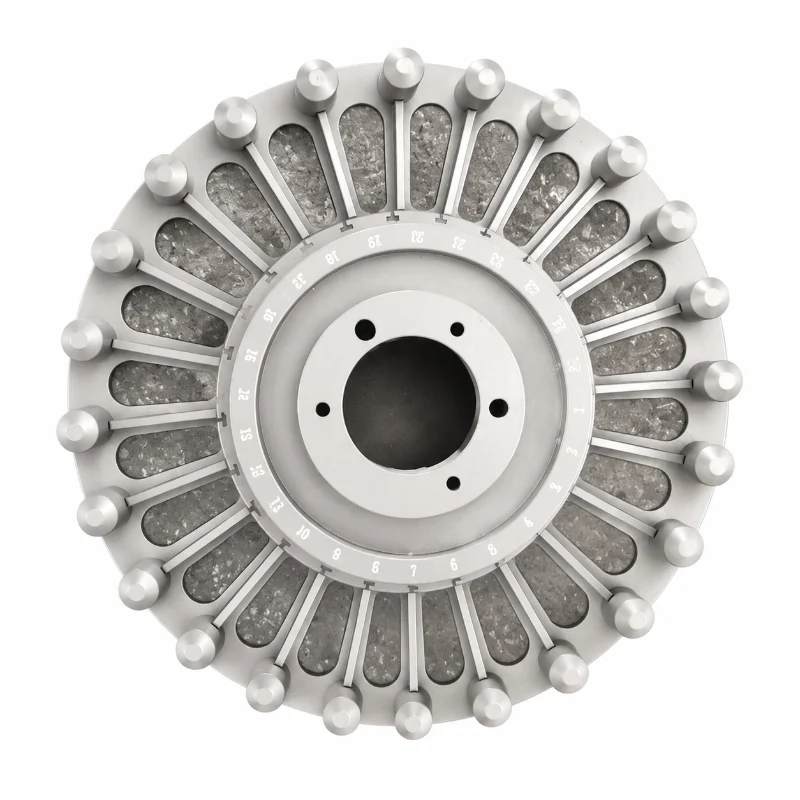
Wire EDM Precision Rotor Component
A precision‑machined rotor‑style component manufactured using Wire EDM Machining, engineered for intricate internal and external profiles that require micron‑level accuracy, perfect surface integrity, and clean intersecting geometry. This part exemplifies advanced EDM capability for high‑performance assemblies where conventional machining falls short.
- Process Accuracy: ±0.01–0.03 mm (depending on geometry and material)
- Materials: Hardened steel, stainless steel, titanium alloys, aluminum alloys
- Surface Finish: Ra 1.6–3.2 μm typical, burr-free edges
- Feature Types: Radial slots, internal profiles, concentric holes, intersecting contours
- Workpiece Size: Up to 300 × 300 × 100 mm (customizable)
- Batch Runs: Prototype, small-batch, medium-volume production
Share:


- Description
- Specification
- Application
- FAQS
This rotor component features a multitude of closely spaced radial spokes, circular cutouts, and intersecting internal profiles that challenge traditional machining methods. Achieving uniform wall thickness, smooth internal contours, and precise symmetry across the entire circumference requires a process that can accurately reproduce fine geometry without mechanical contact — making Wire EDM Machining particularly suitable.
Wire EDM uses a fine‑diameter wire and controlled electrical discharges to erode material with exceptional precision. The process is ideal for this part’s complex layout because it can produce razor‑sharp internal corners, burr‑free surfaces, and intersecting profiles that cannot be reached easily with milling. The non‑contact cutting avoids thermal distortion and tool deflection, preserving material properties and ensuring dimensional stability.
At CIXIN, our Wire EDM workflow combines sophisticated fixturing, real‑time spark control, and sequential machining strategies to ensure that all radial features and internal contours meet strict tolerance and surface finish requirements. High‑resolution inspection is integrated throughout production to maintain consistent part quality from prototype through to medium‑volume runs. This approach delivers components that are ready for assembly without extensive post‑processing, reducing overall lead times while improving functional reliability.
| Parameter | Details |
| Material | Hardened steel / Stainless steel / Titanium / Aluminum alloys |
| Typical Tolerance | ±0.01–0.03 mm |
| Surface Finish | Ra 1.6–3.2 μm, burr-free edges |
| Feature Types | Radial slots, internal profiles, concentric holes, intersecting contours |
| Max Workpiece Size | Up to 300 × 300 × 100 mm (customizable) |
| Production | Prototype → Small batch → Medium volume |
- Aerospace Modules: Repeatable geometry and concentric accuracy are critical.
- Medical Devices: Components requiring precise motion control and tight clearances.
- Industrial Automation: Parts used for guiding, indexing, and supporting mechanisms.
Q1: Why choose Wire EDM over conventional machining for this part?
Because the part contains deep internal cavities, tight radial features, and intersecting contours. Wire EDM delivers burr‑free edges, sharp internal corners, and consistent tolerance that milling or drilling cannot reliably achieve.
Q2: Does Wire EDM affect material properties?
No. Since the process uses controlled electrical erosion without mechanical cutting forces, it maintains material microstructure and eliminates stress and heat distortion.
Q3: What materials are suitable for this service?
High‑hardness steels, stainless steels, titanium, and other engineering alloys are well supported — including materials difficult to machine by traditional methods.
Q4: Is secondary finishing required?
Often not. Wire EDM produces clean surfaces and sharp profiles that meet assembly requirements with minimal post‑processing.
Q5: Can this part be produced in volume?
Yes. CIXIN supports from prototype and small batch orders to medium‑volume production with consistent quality contro